


SURVEY REPORT


The State of Cloud
Security Report 2026
The largest global survey of cloud security
professionals.
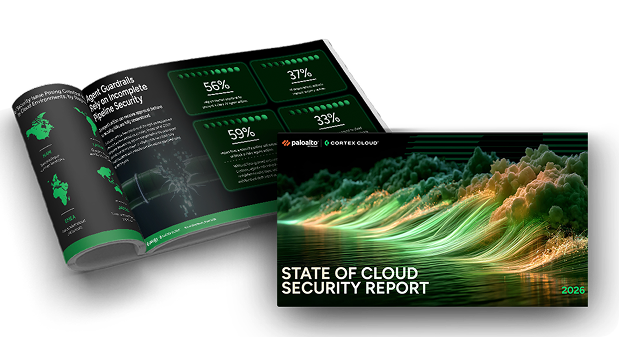
Highlights of the 2026 report findings
Where AI is pushing cloud security into new frontiers of risk.
0%
of orgs use AI agents in the development pipeline.
0%
give agents authority to create or change code, infrastructure or delivery workflows.
0%
say AI-driven development has increased infrastructure updates reaching the cloud.
0%
of organizations are unable to reconstruct an AI agent’s actions.
0
days are required on average to deploy a security fix once it’s been identified.
0%
of high and critical application security issues on average reach production.
Threat outlook
70% consider frontier AI-powered capabilities a significant or severe threat to critical global infrastructure (global: 65%).
Risk context
55% of organizations are still manually correlating application vulnerabilities with runtime data, exceeding every region in the study (global: 47%).
Security strategy
28% of organizations are consolidating around an integrated security platform (global: 23%).

Threat outlook
32% of organizations are extremely concerned about frontier AI-powered threats to their organizations, the highest population of any region (global: 26%).
Code remediation
27% take 30–60 days to deploy a security fix (global: 13%).
Capability priorities
33% name managing AI agent identities and entitlements their top 12-month priority (global: 27%).

Operational readiness
14% say their operating model isn’t prepared for AI-era cloud risk (global: 8%).
Production AI
8% of organizations do not run AI systems in production, the largest population among regions (global: 4%).
Application exposure
39% report hardcoded cloud credentials among the application weaknesses most likely to create exposure (global: 36%).

Risk context
60% of organizations automatically correlate application vulnerabilities to runtime, the highest of any region (global: 53%).
Threat detection
24% can detect cloud threats within four hours (global: 19%).
Application exposure
41% identify insecure deployment pipelines as their primary cloud exposure (global: 37%).

Risk context
33% automatically correlate application vulnerabilities with runtime through a unified platform, the broadest adoption across sectors (global: 23%).
Operational readiness
56% describe their security operating model as very prepared for AI-era cloud risk, the highest percentage selecting this rating across sectors (global: 41%).
Threat preparation
55% are actively restructuring their defenses for frontier AI-powered threats (global: 46%).

Credential response
49% can revoke nonhuman access automatically and granularly, leading all sectors in this capability (global: 32%).
Threat outlook
79% consider frontier AI-powered capabilities a significant or severe threat to global infrastructure, the highest percentage across sectors (global: 65%).
Production AI
72% run AI systems in production, the lowest adoption rate of any sector (global: 79%).

Operational readiness
27% describe their security operating model as very prepared for AI-era cloud risk, the lowest percentage selecting this rating across sectors (global: 41%).
Threat detection
77% detect cloud threats within 24 hours (global: 68%).
Capability priorities
34% rank managing AI agent identities and entitlements among their top three security priorities for the next 12 months (global: 27%).

Agent identity
48% of organizations have encountered incidents tied to excessive permissions assigned to AI agents in the past 12 months (global: 38%).
Agent activity
50% use AI agents in security testing, the highest adoption rate of any sector (global: 44%).
Cloud incidents
27% experienced a data breach in the past 12 months (global: 21%).

Research scope
We surveyed 2.8K people
Representing both executive leadership and practitioners from cloud security across 13 industries
Across 10 countries
U.S.
Australia
Brazil
France
Germany
India
Japan
Mexico
Singapore
U.K.


Frequently asked questions
Palo Alto Networks publishes the report annually to document how organizations secure their cloud environments. The 2026 edition is the sixth in the series.
Security leaders lack an independent, peer-based benchmark for judging their cloud security practices. The report gives them one, drawn from the people who run those programs.
Palo Alto Networks rebuilt the survey around AI’s impact on cloud security. The questionnaire examines how AI changes software development, identity and access, threat exposure, and security operations.
CISOs, cloud security leaders, application security teams, and SOC leaders who plan, fund, or run cloud security programs.
The survey reached 2,800 security and technology professionals at organizations with 500 or more employees and $100 million or more in annual revenue. Respondents include executives and practitioners across application security and development, SOC, and cloud operations and security roles. They work in 13 industries, including financial services, healthcare, technology, manufacturing, and utilities.